Mongolia’s carbon-market debate has moved from whether the country should participate to how participation should be governed. UNEP Copenhagen Climate Centre now records four bilateral carbon-market agreements involving Mongolia: the Joint Crediting Mechanism with Japan, cooperation with the Republic of Korea, and implementation arrangements with Singapore and Switzerland.
In July 2026, Parliament adopted Mongolia’s first Climate Change Law, providing a legal basis for national, bilateral, multilateral and voluntary carbon-market activity. During UNCCD COP17 in August, Mongolia also introduced the demo version of its national carbon registry, another core piece of infrastructure for recording projects, issuances and transfers.
The market is therefore becoming operational. The more important economic question is how Mongolia can turn that infrastructure into high-integrity projects and investment while protecting its own climate commitments.
The clearest evidence is the Mongolia–Japan JCM. On 30 June 2026, the bilateral Joint Committee approved the issuance of 214,040 credits from four renewable-energy projects. On 6 July, the two governments completed Mongolia’s first international transfer under Article 6, authorizing 86,564 tCO₂e of ITMOs for transfer to Japan.
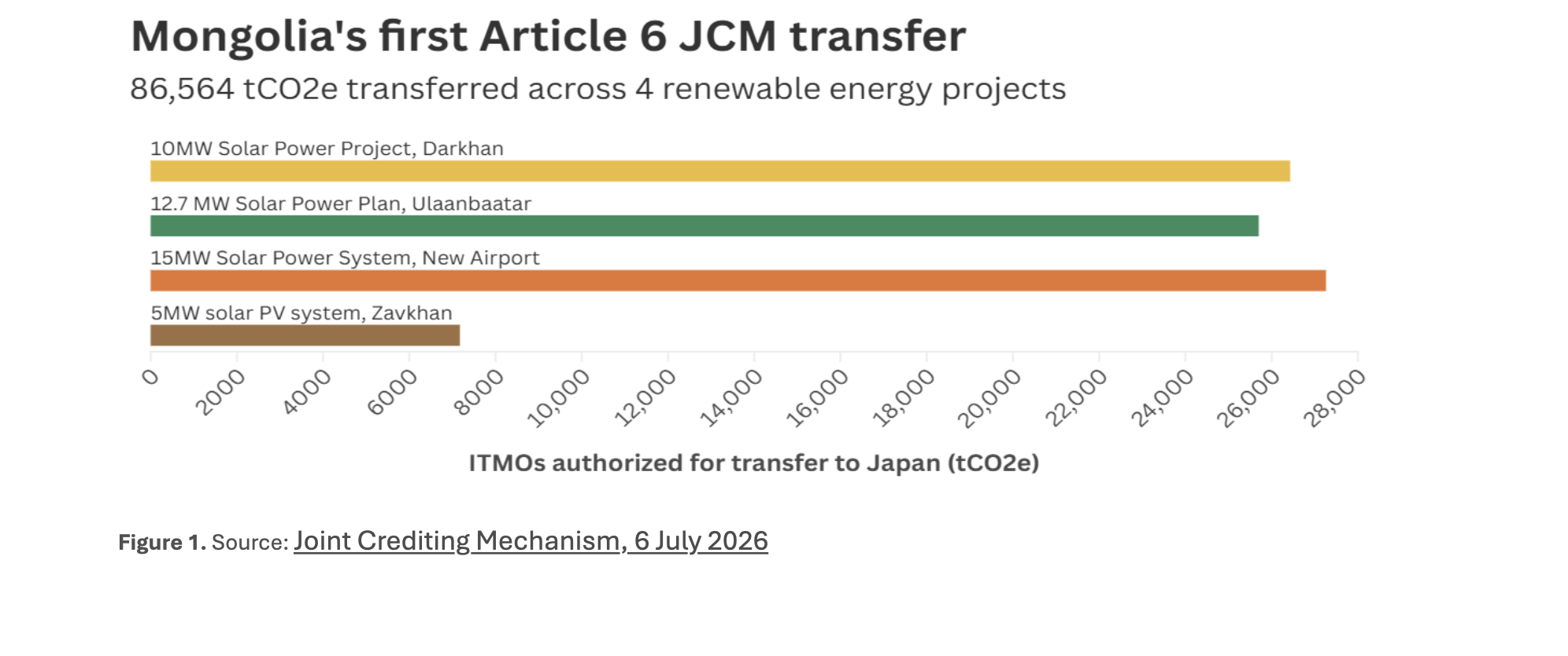
The four projects are not pilots on paper: they include 12.7 MW, 10 MW and 15 MW solar projects and a 5 MW solar-plus-battery project in Zavkhan. Across its full issuance history, the official JCM platform records seven Mongolian projects that have reached credit issuance and 343,360 in total notified amounts.
A different model is developing at household level. Through UNDP’s Solar Facility with Ulaanbaatar City and URECA, the first 68 participating households generated 392 tonnes of Gold Standard carbon credits by replacing coal heating with solar generation, batteries, electric heating and smart meters. The volume is small, but the model demonstrates how digital MRV and carbon revenue can be built into a locally developed clean-heating investment.
A national carbon-market estimate should not be built from one sector. Mongolia’s NDC 3.0 covers mitigation across energy generation and consumption, transport, industrial processes, agriculture, waste and forestry. The 2026 Mongolia–Japan Article 6 business forum also presented potential projects in waste-to-energy, agrivoltaics, district heating, heat pumps and grassland restoration. Under the Mongolia–Singapore framework, the Government has similarly identified renewable energy, energy efficiency, waste management, reforestation, intensive agriculture, environmental rehabilitation and sustainable infrastructure as areas for cooperation.
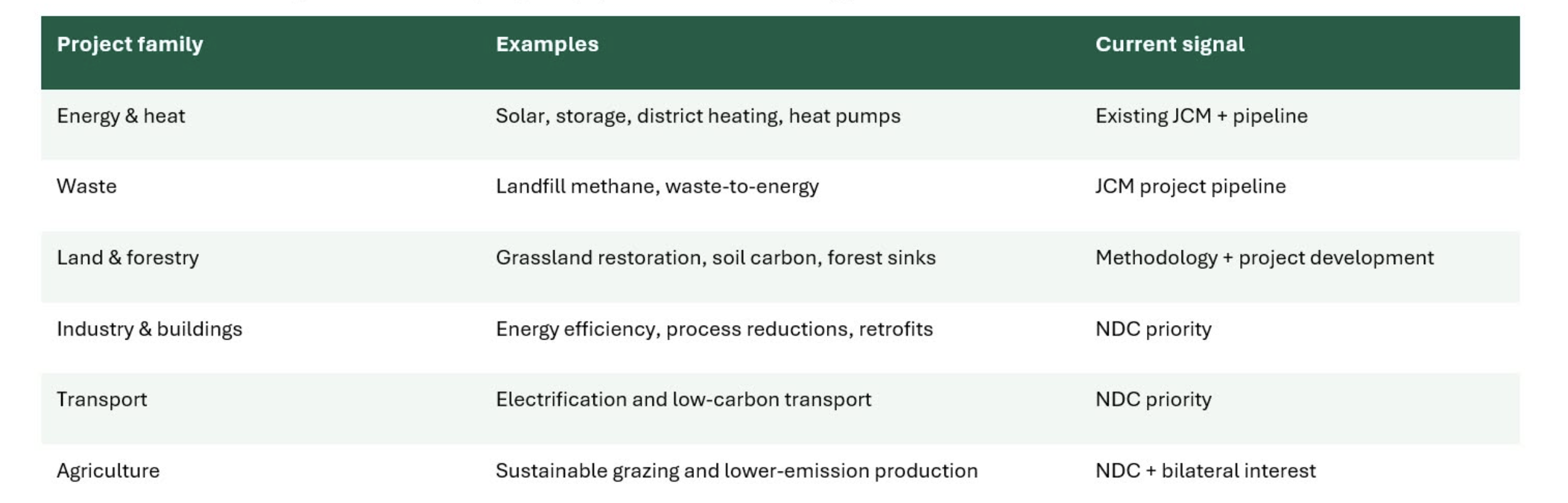
Rangelands remain important because they are one of the few areas for which a national-scale technical estimate is available. UNDP research estimates that sustainable soil-management practices could sequester about 4.69 million tonnes of carbon annually, equivalent to roughly 17.2 million tCO₂. Separately, NDC 3.0 estimates that enhanced forest management could add 3.3 million tCO₂e of sequestration by 2035.
These figures should not be added together and labelled “Mongolia’s carbon-credit potential.” They measure different things and sit on different time horizons. A creditable volume still depends on project boundaries, additionality, permanence, leakage, monitoring quality, verification, safeguards, ownership and government authorization. The correct national approach is therefore to build a portfolio of project pipelines and value them project by project.
Price can change the economics materially. The World Bank’s State and Trends of Carbon Pricing 2026 reports that most carbon-credit types traded around USD 1–14/tCO₂e during 2025, while CORSIA-eligible credits traded at roughly USD 15–22/tCO₂e from September 2025, reflecting the premium attached to international compliance eligibility and perceived quality.
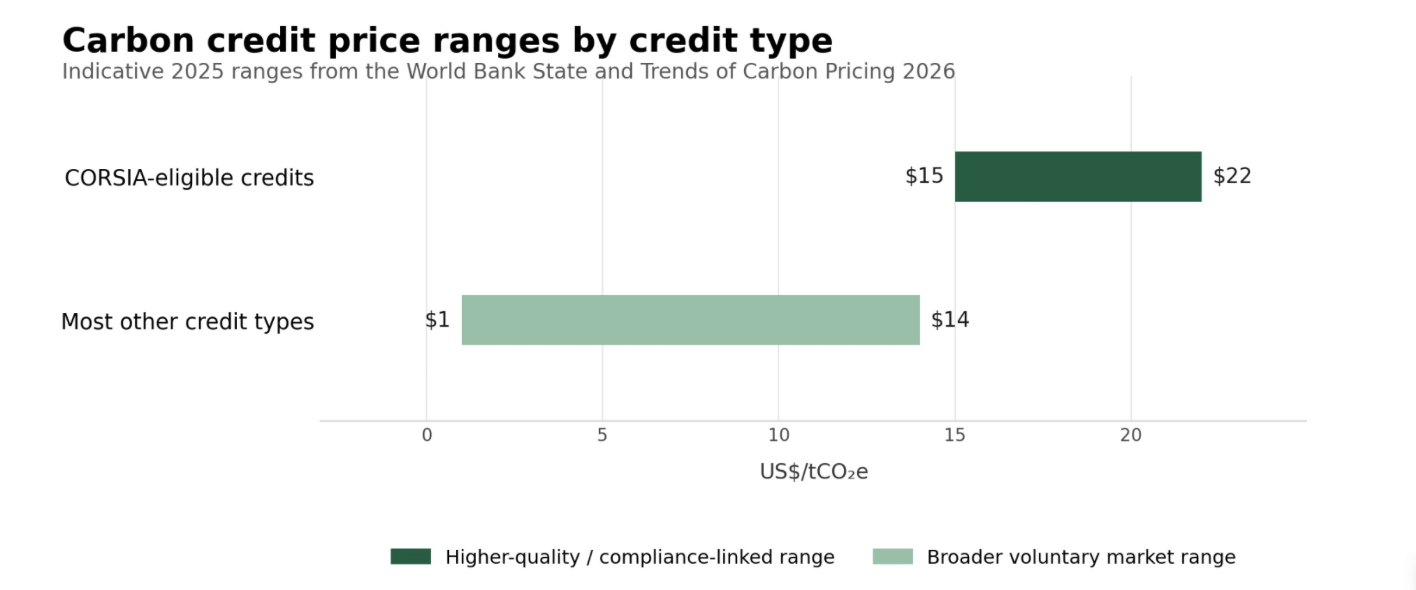
Figure 2. Source: World Bank, State and Trends of Carbon Pricing 2026 Price ranges shown for 2025 / early 2026.
For a project developer, the implication is straightforward: one million verified credits would represent roughly USD 1–14 million of gross revenue at the broad 2025 market range, or USD 15–22 million if the credits qualified for pricing comparable to CORSIA-eligible units. These are valuation sensitivities, not forecasts. Actual Article 6 transaction prices can be privately negotiated, and Mongolia’s JCM transfer price has not been publicly disclosed.
This is also why applying a carbon price to the entire 17.2 million tCO₂ technical rangeland estimate would overstate the market. The economic opportunity is potentially large, but value will come from the share of reductions that can be converted into high-integrity, financeable and authorized credits.
The constraint is Mongolia’s own NDC. By 2035, NDC 3.0 targets 24.7 million tCO₂e of unconditional emission reductions, an additional 3.3 million tCO₂e of forest sequestration, and 3.9 million tCO₂e of conditional reductions with full international support. The NDC also plans restoration of 10% of heavily degraded rangelands, butdoes not assign that measure a quantified sequestration figure.
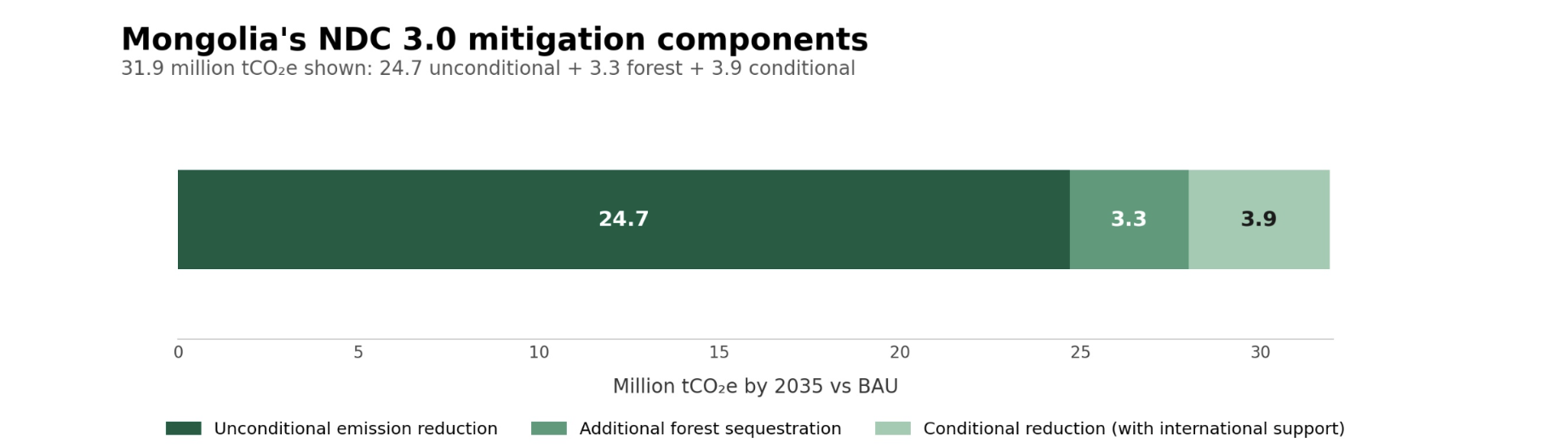
Figure 3. Source: Mongolia NDC 3.0, UNFCCC Rangeland restoration is not included because the NDC does not quantify its sequestration contribution.
Under Article 6, a mitigation outcome authorized for international transfer requires a corresponding adjustment. In practical terms, the same tonne cannot both support Mongolia’s NDC accounting and be counted by the acquiring country. Export authorization is therefore an asset-allocation decision: Mongolia needs to understand the opportunity cost of each tonne before it is transferred.
This argues for a national portfolio strategy rather than case-by-case approvals alone. Low-cost reductions that Mongolia is likely to need for its own target may be more valuable domestically. Projects that require international capital, advanced technology or carbon revenue to become viable may be stronger candidates for Article 6 finance, provided the accounting and additionality are clear.
The Mongolia–Singapore agreement already illustrates that headline credit revenue is not the same as freely available income. Singapore is committed to channeling value equivalent to 5% of authorized credits toward adaptation in Mongolia and cancelling 2% of correspondingly adjusted credits at first issuance as a contribution to overall mitigation.
Mongolia’s broader financing requirement is much larger than any realistic near-term carbon-credit revenue stream. NDC 3.0 estimates USD 14.84 billion of financing needs between 2025 and 2035: USD 9.64 billion for mitigation and USD 5.2 billion for adaptation. Transport requires about USD 3.74 billion, energy USD 3.27 billionand construction USD 1.83 billion. Water alone accounts for about USD 3.24 billion of adaptation needs.
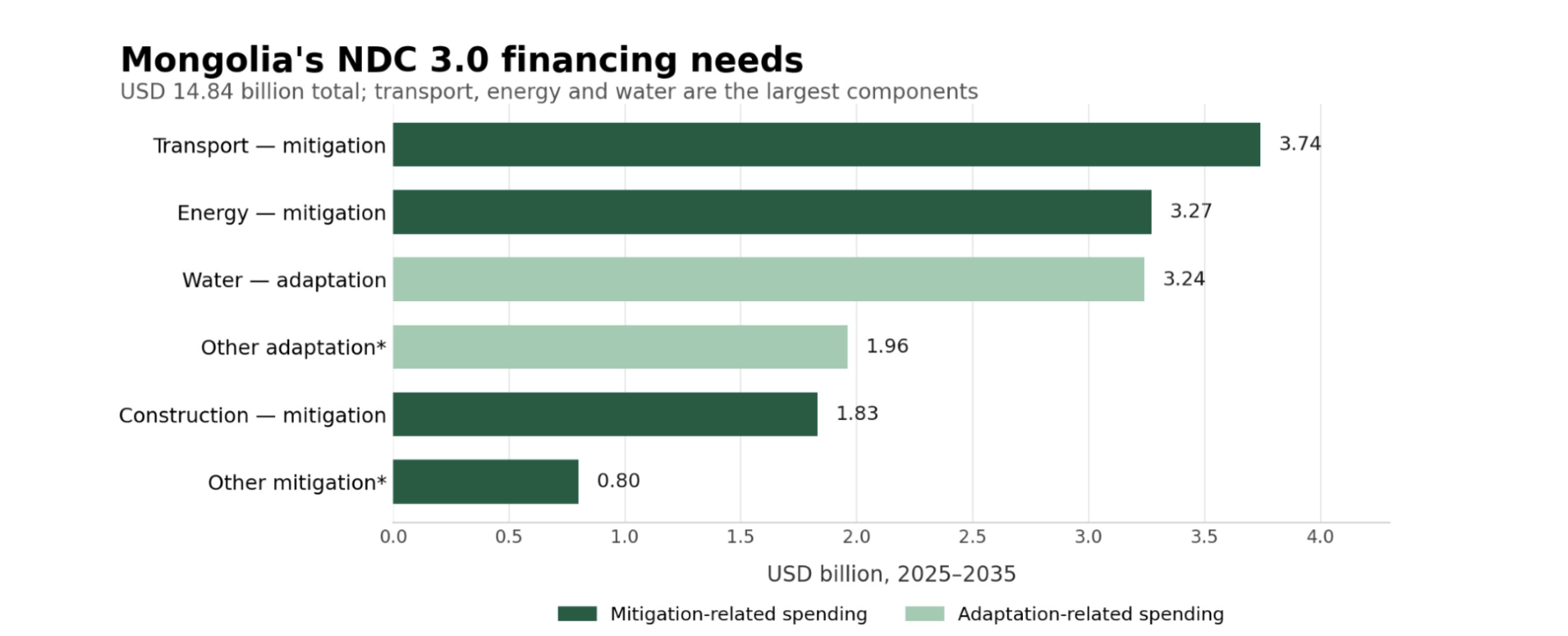
Figure 4. Source: Mongolia NDC 3.0, UNFCCC *Other mitigation and adaptation are calculated residuals from the official totals after the named sectors.
Many of these investments will never generate a tradable carbon credit. Water security, disaster preparedness, climate-resilient infrastructure and several adaptation measures create economic value by reducing losses and improving resilience rather than by producing measurable carbon tonnes.
The Solar Facility itself makes this point: UNDP notes that carbon revenues will not be sufficient to scale clean heating across Ulaanbaatar and that commercial lenders and financial institutions will also be needed. Carbon finance should therefore sit alongside conventional project finance, public investment, concessional lending, guarantees, green and sustainable finance, blended finance and public-private partnerships.
Mongolia’s next generation of carbon projects is already moving toward land. In March 2026, UNDP published operational guidelines and a general methodology for rangeland carbon sequestration. In February, the Mongolia–Japan JCM Joint Committee also recorded a “no objection” decision for a planned Mongolian grassland restoration project based on sustainable grazing practices.
That direction is strategically important because land projects can combine carbon sequestration with pasture productivity, herder livelihoods, biodiversity and drought resilience. It also raises harder integrity questions around permanence, land rights, benefit sharing and measurement, which will need to be resolved before large volumes can reach international buyers.
Beyond carbon, new nature-finance instruments are also developing internationally. High-level principles for biodiversity credit markets were published in 2025, but biodiversity is localized and non-fungible, making it fundamentally harder to standardize than a tonne of CO₂. Gold Standard has also operated Water Benefit Certificates since 2014, providing a model for financing verified water outcomes. These instruments should be treated as emerging, project-specific nature-finance mechanisms rather than assumed to become carbon-market equivalents.
Mongolia now has the foundations of a functioning carbon market: bilateral agreements, a Climate Change Law, an international transfer, operating credit-generating projects, a national registry under development and new land-sector methodologies.
The next stage is more demanding. Government needs clear rules on which sectors and mitigation outcomes can be authorized for export, how much should be retained for NDC delivery, and how benefits and risks are shared. Companies need bankable projects, credible baselines, strong MRV and conservative carbon-revenue assumptions. Financial institutions need to treat carbon income as one layer of project economics rather than the entire financing case.
Most importantly, Mongolia should continue developing energy, water, land, infrastructure and climate-resilience projects at scale even where no carbon-credit methodology exists. Carbon markets can help finance the transition, but the stronger national strategy is to use them selectively: to unlock additional investment, reward measurable outcomes and build productive assets that remain in Mongolia after the credits have been transferred.
This is the 3rd article in a series by Onch & Company examining how structural changes associated with the green transition are reshaping markets, investment and competitive strategy in Mongolia.